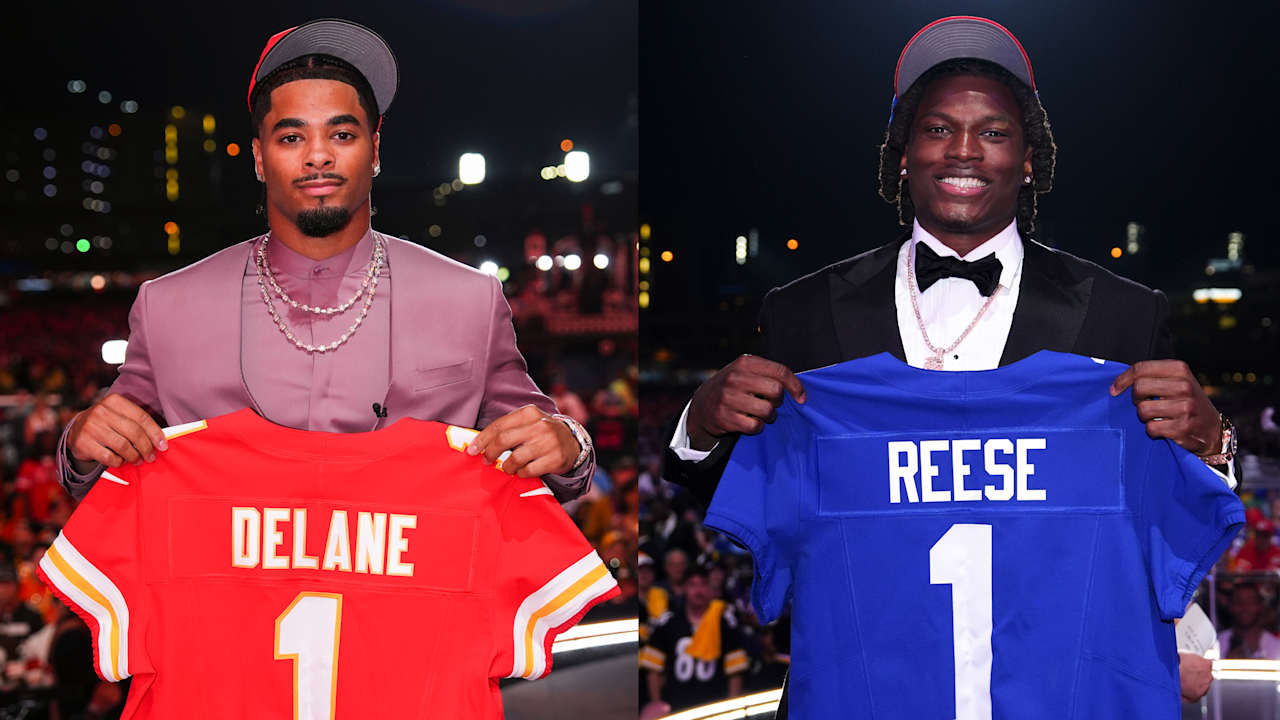
The Kansas City Chiefs aren’t just defending champions in name—they’re reasserting dominance early in the 2026 NFL landscape. After a disciplined and strategically layered draft, the Chiefs have vaulted into the top tier of early-season power rankings. Meanwhile, the San Francisco 49ers, despite landing high-upside talent, are drawing criticism for a familiar pattern: reaching on prospects beyond their board value.
This divergence in draft philosophy is reshaping narratives—and legitimate expectations—for two of the league’s most consistent contenders.
Chiefs’ Draft Precision Fuels Rise in Power Rankings
The Chiefs entered the 2026 draft with a clear mission: replenish the defense and shore up the offensive line without sacrificing long-term flexibility. They executed that plan with surgical precision.
In the first round, Kansas City selected Alabama edge rusher DeShawn Reed with the 29th overall pick. Widely projected as a mid-to-late first-rounder, Reed brings elite bend and hand-fight skills that fit Steve Spagnuolo’s aggressive scheme. The pick was both value-driven and need-based—a rare combination in modern drafts.
Round two saw the Chiefs trade down from 60th to 68th, acquiring an extra fourth-rounder from the Titans, then selecting Oregon center Jordan Pike. Pike’s zone-blocking pedigree complements the Chiefs’ run scheme and offers a long-term replacement for Creed Humphrey.
By day three, Kansas City was capitalizing on depth, selecting: - A.J. Daniels, CB, Cincinnati (Round 3, 83rd) - Malik Grant, WR, UCF (Round 4, 121st) - Darius Ligon, DT, NC State (Round 5, 160th)
Each selection addressed a specific gap while staying within scouting consensus—no hype-driven reaches, no ego picks. The result? A draft class graded among the top three league-wide by multiple outlets, and a clear signal that the Chiefs’ player-evaluation machine remains unmatched.
Why Analysts Are Raising Chiefs’ Ceiling
Early power rankings from ESPN, NFL.com, and The Athletic have slotted the Chiefs in the top five—up from preseason rankings in the teens. The leap isn’t just about new talent; it’s about continuity, fit, and football IQ.
“We’re seeing a front office that’s not reacting to noise,” said longtime draft analyst Marcus Bell. “They’re not chasing stars. They’re building margins—small advantages across the depth chart. That’s how you sustain excellence.”
Consider the Chiefs’ offensive line: Pike may not start immediately, but his presence allows Joe Thuney to slide back to left guard full-time, improving pass protection continuity. Similarly, Ligon gives the interior D-line rotational pop against mobile QBs—a weakness exposed in last year’s playoff loss to Buffalo.
These aren’t splashy moves. They’re fixes. And in the NFL, fixes often matter more than fireworks.
49ers’ Draft Raises Familiar Red Flags
If the Chiefs exemplify restraint, the 49ers embody the tension between hope and hubris.
San Francisco opened the 2026 draft with LSU quarterback Cade Klubnik at No. 22—a move that drew immediate scrutiny. Klubnik, a dual-threat with electric college tape, slid due to durability concerns, mechanical flaws, and questionable decision-making under pressure. Most boards had him as a third- or fourth-round projection.
But Kyle Shanahan and John Lynch, eager to find a long-term heir to Brock Purdy, opted to “bet on talent.” The decision smacks of their 2023 selection of QB Brandon Aiyuk at No. 20—another reach that paid moderate dividends but cost them additional assets.
Their second-round pick, Georgia safety Malik Harris, was solid value. Harris is a rangy, downhill enforcer who fills a need after Talanoa Hufanga’s injury-plagued season. But the third-round choice—Tennessee tackle Kiyan Williams at No. 75—was again, a reach. Williams, a raw athlete with upside, was widely graded as a fifth-rounder.
A Pattern of Reaching on Potential
The 49ers’ drafting tendency isn’t new. Since 2020, they’ve selected players above consensus board value in 60% of their top-75 picks. While some—like Deebo Samuel and Aiyuk—have panned out, others (Javon Kinlaw, Trey Hill) have underperformed or been hampered by injuries.
This overvaluation has consequences: - Diminished draft capital in future years - Pressure on high picks to produce immediately - Limited depth development in later rounds
In 2026, that trend continued. Williams and Klubnik are both high-upside plays, but neither was a consensus top-75 talent. Meanwhile, the 49ers ignored pressing needs at linebacker and nickel cornerback—areas where mid-round value was abundant.
“It’s not that Klubnik can’t succeed,” noted draft strategist Elena Rodriguez. “It’s that you don’t spend a second-tier first-rounder on a developmental QB unless you’re out of options. Purdy’s under contract through 2027. This wasn’t necessity. It was impatience.”
How Draft Strategy Shapes Power Rankings
Power rankings aren’t just about last season’s record. They’re forward-looking evaluations based on roster health, coaching, scheme fit, and—critically—draft success.
Teams that draft efficiently tend to outperform early-season expectations. Those that reach often start slow, burdened by the weight of unmet potential.
| Team | Draft Grade (2026) | Power Rank Change | Key Draft Move |
|---|---|---|---|
| Chiefs | A+ | +8 spots | Value picks, depth additions |
| 49ers | C+ | -2 spots | Reaching on QB, tackle |
| Ravens | A | +5 spots | Trade up for elite TE |
| Lions | B+ | +3 spots | Balanced, need-focused |
The Chiefs’ rise reflects confidence in their process. The 49ers’ stagnation—or slight drop—reflects skepticism about their judgment.
Roster Fit vs. Talent Betting: A League-Wide Divide
The Chiefs-49ers contrast is part of a broader philosophical split in NFL front offices.
On one side: process-driven teams (Chiefs, Ravens, Bills) who treat the draft as a risk-mitigation exercise. They prioritize fit, reliability, and board discipline. They rarely “win” draft weekend in the court of public opinion—but they consistently field contenders.
On the other: talent-driven teams (49ers, Cowboys, Jets) who bet on athletic upside, often trading up or reaching for “difference-makers.” These teams generate buzz but face higher bust rates and roster instability.
The data is clear: from 2018 to 2025, teams with disciplined draft approaches made the Super Bowl at twice the rate of those who regularly reached on prospects.
What the Chiefs Do Differently
Kansas City’s front office, led by Brett Veach, operates like a hedge fund: diversified, low-variance, long-term focused.
- They rarely trade up, preserving capital.
- They target developmental players with high football character.
- They prioritize scheme fit over raw measurables.
- They leverage analytics without being ruled by them.
Result? Since 2019, 80% of their Day 2 and 3 picks have made the active roster, compared to the league average of 52%.
Where the 49ers Keep Stumbling
San Francisco’s model isn’t flawed—it’s just inconsistent.
They excel at developing talent post-draft (see: Nick Bosa, Aiyuk). But their pre-draft evaluations often overvalue athleticism and underweight medicals and consistency.
Klubnik, for example, missed six games in 2025 due to rib and ankle issues. Williams played just eight games in his final college season. Both were injury-prone, unrefined prospects—exactly the kind the 49ers have whiffed on before.
“Teams that reach often do it because they overestimate their coaching’s ability to fix flaws,” said former Bears GM Phil Emery. “But not every raw athlete becomes a star. Some just become injured backups.”
Power Rankings Aren’t Final—But They’re Telling
Early power rankings are fluid. Injuries, free agency, and coaching changes will shift them. But draft performance is a leading indicator.
The Chiefs’ climb isn’t just about adding Reed and Pike—it’s about reinforcing a culture of excellence. Every pick sends a message: we prepare, we adapt, we execute.
The 49ers, meanwhile, are sending a different message: we believe in our eye, even when the numbers disagree.
That confidence can pay off. But history suggests it often doesn’t.
What Comes Next for Both Teams For the Chiefs, the path is continuity. Patrick Mahomes still has prime years left. Andy Reid’s offense evolves with new personnel. And with a deeper, more balanced roster, Kansas City enters 2026 as a legitimate Super Bowl favorite.
Their challenge? Avoiding complacency. With another strong draft in the books, the temptation to coast is real. But in the AFC, one misstep means playoff seeding—and home-field advantage—slips away.
For the 49ers, it’s about patience. Klubnik won’t start in Week 1. Williams may redshirt. The defense still has gaps. But if Shanahan’s staff can develop these high-upside picks—and stay healthy—their gamble could redefine the NFC West.
Yet every reach increases the pressure. Every missed need compounds future risk. And in a division with the Seahawks’ depth and the Rams’ resurgence, there’s little margin for error.
The Bottom Line: Process Over Hype
The 2026 NFL Draft didn’t crown champions. But it revealed who’s building smartly—and who’s betting on hope.
The Chiefs’ rise in power rankings is no fluke. It’s the result of a system that values consistency, fit, and long-term vision. They didn’t swing for the fences. They chipped away, piece by piece.
The 49ers? Still chasing the big win. Still enamored with athletic upside. Still reaching when value is on the board.
One approach leads to sustained contention. The other leads to cycles of boom and bust.
As the season unfolds, watch the margins. Watch the depth. Watch who handles adversity better when injuries hit.
The draft doesn’t end in April. But its consequences play out all year.
FAQs
Why are the Chiefs rising in power rankings after the draft? The Chiefs executed a disciplined draft, landing high-value players at key positions without sacrificing future capital, reinforcing their status as Super Bowl contenders.
Did the 49ers make a mistake drafting Cade Klubnik? It’s less about the player and more about the pick value. Taking a developmental QB at No. 22, when better options were available, is seen as a reach and a misallocation of resources.
How do draft decisions impact NFL power rankings? Power rankings factor in roster strength, depth, and long-term outlook. Strong drafts boost team ceilings; reaches create uncertainty and lower grades.
Are the 49ers bad at drafting? No—they’ve had successes. But they consistently reach on prospects, which increases bust risk and limits depth development compared to more disciplined teams.
What makes the Chiefs’ draft strategy effective? They prioritize fit, value, and board discipline, avoid trades up, and focus on long-term roster construction over short-term headlines.
Can the 49ers’ 2026 draft class still succeed? Yes—development matters. If Klubnik and Williams thrive under coaching, the picks could validate. But the odds are against high-reach selections.
Who benefits more from their 2026 draft class? The Chiefs. Their picks address immediate needs with minimal risk. The 49ers took higher-risk swings that may take years to evaluate—and could backfire.
FAQ
What should you look for in Chiefs Climb NFL Power Rankings After Draft Surge? Focus on relevance, practical value, and how well the solution matches real user intent.
Is Chiefs Climb NFL Power Rankings
After Draft Surge suitable for beginners? That depends on the workflow, but a clear step-by-step approach usually makes it easier to start.
How do you compare options around Chiefs Climb NFL Power Rankings After Draft Surge? Compare features, trust signals, limitations, pricing, and ease of implementation.
What mistakes should you avoid? Avoid generic choices, weak validation, and decisions based only on marketing claims.
What is the next best step? Shortlist the most relevant options, validate them quickly, and refine from real-world results.